NB: I am transitioning to Substack, so this post can also be found here.
How happy am I to be a year older? SO HAPPY! When I was diagnosed more than a year ago, I thought I might be dead by now, and I’m delighted to report that I’m not.
Birthdays are a good time to reflect, and so below are some thoughts I’ve had recently about my experience of having cancer. As Stephanie says, “I will not thank cholangiocarcinoma for anything,” but I will say that, amid the fatigue and worry, this past year has been stuffed full of wonder, joy, laughter, and, I don’t know quite how to put it, but something like new intellectual fervour. And much of that is either because I’ve willfully cultivated, nurtured, and savoured it, knowing I might not have long, and much of it is because my people have gathered to me and around me, enfolding me in love.
Before I embark on my reflections, I will tell you who I am. I’m 99% sure this is not some big reveal. Some of the people who read this blog are friends, and so they already know who I am. And most of the people who read this have come here because I’ve posted the link to this blog on cholangiocarcinoma Facebook pages, using my name, and so they too know who I am (or at least could easily google me). And anyone else could probably have figured it out pretty easily if they wanted to. But I did start this blog, more than a year ago, in a fairly anonymous way (“I am a professor at a Canadian university…”). At the time I had only told family and close friends about my diagnosis, and I wasn’t sure how public I wanted this blog to be. I’m normally a pretty private person and don’t like feeling exposed — when I was subscribed to Twitter, for example (and I dropped that platform pretty quickly), I never posted anything. It all just felt too naked to me (though also, ironically, full of total posers). So, my approach to the blog was, “it’s public, if people find it, they find it, but I’m not going to promote it.” Only gradually did I become comfortable sharing the link to the blog in a more open way that would draw in people I don’t know. In any case, I am now finally at ease being public about the fact that I have this disease and I write this blog. My name is Holly Wardlow, I’m a professor in the Anthropology Dept at University of Toronto, and I’m originally from the USA but have lived in Canada for almost 25 years. I was a Peace Corps volunteer in Papua New Guinea (PNG) after university, and then, because of the amazing nature of that experience, I became an anthropologist and did all my research there (a fact that has relevance to one of my reflections below).
And now the reflections.
(1) Not having even a rough idea of how much time you have is disorienting. I know that none of us know how much time we have, that anyone could be hit by a bus tomorrow, and so on, but there is a difference between that kind of abstract unknowable time horizon and the time horizon where you think you are probably safe planning a hiking trip a couple of months from now, but probably shouldn’t buy a subscription to the opera for 2026-27. Sydney Towle spoke about this in one of her TikTok videos. She spoke about it in terms of urgency — the impossibility of knowing whether you should urgently do something, or if you can put it off because you have time, and so it’s not really urgent. Should you take that trip because who knows if you’ll be alive in a few months, or can you postpone it because you will probably be around for at least the next couple of years? And Sydney Towle’s life shows that you really can’t know — she thought she had very little time, and then had far more than she anticipated, and was able to take all kinds of wonderful trips with family and friends. Then she thought she might have time to train for the NYC marathon, and it turned out she had no time at all (I am still really grieving her).
Stephanie has also written eloquently about this: “Five years ago, I was told my future would probably be short. Here is what I have lost instead. Not the future. The tense. My grammar has rearranged itself. The infusion is Wednesday. The scan is in August. If the treatment holds, I might travel. What I rarely say now is next year. Or When this is over. Or Eventually. Someday.“
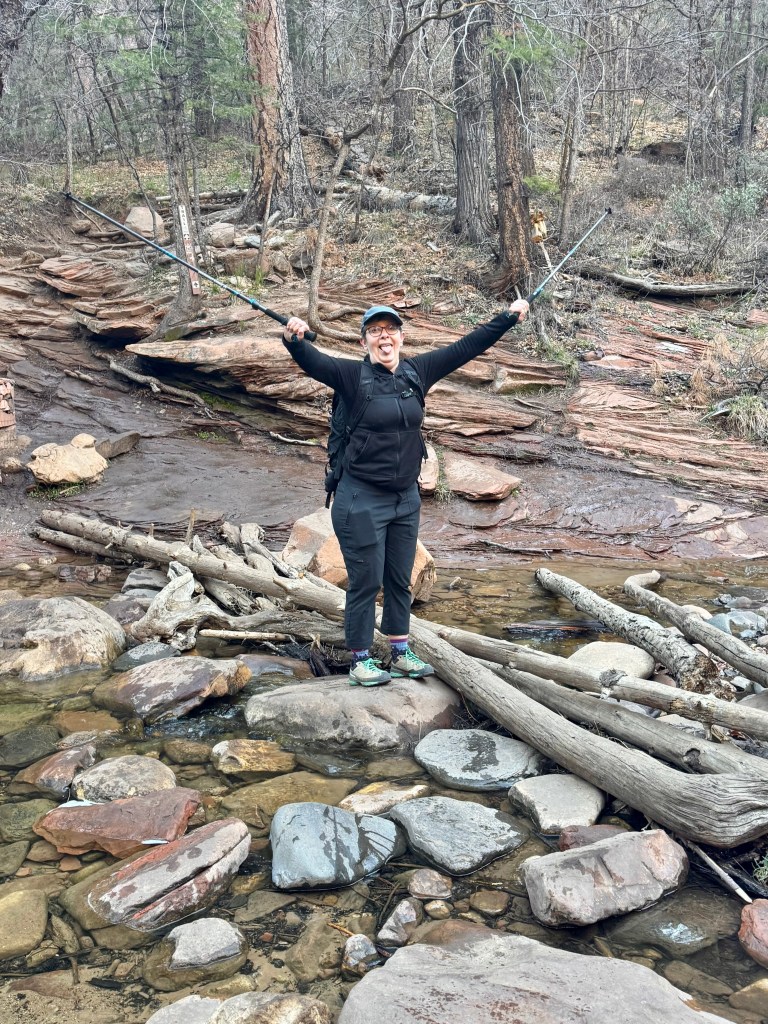
People normally talk a lot in what might be called the large future tense — the fat, rolling green hills, abundant future of years from now, or even “next year.” I notice this more now that I don’t talk in that tense at all. But, on the other hand — whatever…. By which I mean, yes, I think about my time horizon differently now, and I feel constrained to speak in the small future tense, and I shy well away from the large future tense. But what matters to me is my decision that it’s wiser (and probably adds up to more accumulated fun) to err on the side of assuming I have less time. And this has meant seeing my parents, sister, and niece more often, and taking not one, but (fingers crossed for health in September) two hiking trips with best friends, and, without being pushy about it, being involved in things like my step-daughter’s home-buying experience and my niece’s process of visiting possible colleges/universities. And, oh my goodness, the number of standup comics we’ve seen in the past year — probably at least 10! I’ve laughed so much! (And this after a lifetime of pretty much no interest in seeing standup live). And all of this feels like packing in lots of life and love while I can — embracing a large present tense rather than the large future tense.
(2) I’ve become sure that all of this is harder on the caregivers. If it’s hard for me not to know how much time I have, I think it’s harder for my husband. Caregivers can’t help but engage in anticipatory grieving. You can stand right in front of them and say, “I’m still here,” but they have to psychologically prepare at least a little for when you are not. And when no one knows how much time you have, what are they supposed to do psychologically? The uncertainty and the unknowable time horizon is just as hard for them, maybe harder. And it’s not just that, of course. There’s not knowing if the aches and pains felt by the cancer patient are worth panicking over or not. There’s the desire to exert more control over the situation — over the oncologists, over the hospitals, over the drug manufacturers, over the cancer — and the inability to do so. There’s the instinctive urge to protect and save, again without being able to. But really, I probably shouldn’t go on about this. What I should do is ask my husband if he wants to write a guest post about it. What I most want to say is that my husband is a real hero and has totally had my back, and is savvy and strategic and hard-nosed about trying to get me the care I need, all while being really tender and nurturing to me (though also sometimes playing enforcer, like the time I really didn’t want to go to emergency because it was already late and I was so tired and I knew we’d be there for fucking hours, and he insisted, and he was right because I had the flu and ended up needing some serious drugs).
(3) I am slowly coming to accept the freedom of possibly having a curtailed future. I’m not sure how to explain this except to say that it’s taken me more than a year, but I’m finally allowing myself to slip free of the professional expectations of my field. These expectations are captured in the pithy phrase “publish or perish,” but what they really mean Is that you are always working on a research project, or maybe a few, that will result in scholarly publications. It’s not that I’ve been trying to write and publish this whole past year (I haven’t), or that I’ve now decided not to (again, I haven’t). Rather, when I was first diagnosed I went through a period of terrible mourning for a project in Papua New Guinea that I’d started, but had to give up. On my more playful, whimsical days I referred to this as my “women and chickens” project, and on my more serious and professional days I’d say I was doing research about the poultry industry in Papua New Guinea, and especially the role that women play in that industry, both as workers on the processing plant floors, and as the primary caretakers and sellers of household broilers (interestingly, at least to me, most people in PNG who raise chickens do not do so for their eggs; rather, they buy day-old broiler chicks from chicken factories, raise them for 6 – 8 weeks, and then sell them for their meat).
I was in love with this project. If all had gone as planned (in my large future tense modality), I would have spent this past year doing a few research trips to Papua New Guinea to gather data, and then over the next few years I would have written a book about it. It really broke my heart having to give that up. And, of course family and friends are the most important things in life, and no one will go to their grave wishing they’d worked more, but I think it’s a little different when your job lets you choose what you want to research and write about, and you can craft projects that are both interesting to you and meaningful to the people whose lives you are researching. It can be endlessly intellectually stimulating and profoundly fulfilling.
So, it took me a long time to get past that loss. But having cholangiocarcinoma has gradually led me into a new (for me) world of research, and here is where the new intellectual fervour comes in. I’ve started paying attention to things like the metaphors and other language used in cancer research (e.g. I read an article referring to metastases as “settlements” in other areas of the body, and I heard a talk where the researcher talked about tumours having different “neighborhoods”). And I’ve learned a lot about the cumbersome, sluggish drug approval process in Canada, something I knew nothing about before, and is definitely worth writing about (and if you’ve read my earlier posts you know I’ve had a hard time not writing about it because it makes me so mad). And I’m currently trying to write some “autofiction” (storytelling about the self that mixes fact with fiction) about my cancer experience, and I’m thinking about taking a creative writing class to help me do it. Anyway, who knows if I’ll stay well enough long enough to turn any of this into something tangible. Maybe I’ll just end up doing this blog and nothing else (and I love doing this blog, which is also a great discovery for me). But the freedom of letting go of long-ingrained professional expectations is feeling very good right now. (Yes, I’m still working, but please don’t worry, I won’t get fired. The worst that will happen if I fail to produce scholarly publications is I won’t get a merit-based raise. Again, lucky lucky to be in my profession).
(4) Rosie has some wisdom to share. You remember Rosie — she who heroically saved me from a diarrhea disaster by letting me use her bathroom when I was on a walk? I ran into Rosie yesterday while on another walk (movement is medicine, people! Keep moving!). We talked for a long time about her new dog and about one of her neighbors, and eventually she offered me some water to drink. And I said, “you’re too kind,” and because she’s Italian she replied, “Fai bene e dimenticalo, fai male e pensaci.” Her mother always said that, she explained. It means, “Do good and forget it, do bad and think about it.” In other words, put kindness into the world, but do it without expecting praise or expecting someone to return the kindness. Let go of your thoughtful and generous acts. But if you are hurtful to someone or do something wrong, remember it so that you can express remorse and try not to do it again. This is a good motto to bring into my coming year.
Rosie and I also talked about taking Latin in high school. So here is my little birthday song to myself (which won’t make much sense if you haven’t taken some Latin – amo, amas, amat):
Happy Birthday to me,
“Sum, esse, fui”
Means “I am, to be,
I was” a fierce, chemo-slaying, cancer-ass-kicking bitch.
And I still am.


Leave a Reply