Oh, to be blissfully unaware of Canadian drug policy! Returning to that state of ignorance would be so nice. Or rather, never having felt the need to know about it would be so nice. But, ever since we embarked on the quest to obtain zenocutuzumab, it has felt important to have a better understanding of how new drugs get approved (or not) in Canada, and especially why it seems to take so damn long. Probably many Canadian patients and caregivers reading this will be equally or more knowledgeable than I am about this process, and most readers from other countries won’t really care, so maybe this post is mostly just for me to organize my thoughts about it. There’s that famous quote, apparently attributed to EM Forster, “How can I know what I think until I see what I say?”, and this is often true for me. Writing all this down will help me understand it better and help me solidify my feelings about it.
But before I get started, just a few sentences on how I’m doing. How I have been feeling is great. The other day I did a 3-mile walk/run, and then ALSO an online fitness class with lots of squats and lunges (ok, yes, I was tired after, and needed a nap, but who wouldn’t?) And I’ve been doing tasks I haven’t done for a year — taking the dogs to the dog park, mowing the lawn, doing the food shopping for the dogs, taking the dogs to the vet (yes, lots of dog-related labor, but really, why be alive if you can’t have the joy of caring for your dogs….). The zenocutuzumab has caused some fatigue. In fact, yesterday I suddenly felt like someone had cast a lethargy spell on me: I stepped away from my desk, lay down on my bed in my clothes, including my sneakers, threw half a quilt over myself, and fell headlong into sleep for an hour. But, apart from occasional fits of exhaustion, I’ve felt so absolutely normal that it makes me weep with happiness. The true test will come tomorrow, July 2, when I have a CT scan. Then we will find out if the zeno is doing its job, if my insides match my outsides. In other words — if that damn tumor is getting smaller. I think sometime soon I need to do a post on “scanxiety” — such a silly word for such a big, cavernous feeling.
Ok, new drug approvals in Canada.
Because I would really love it if the cost of the zeno was covered by the government, but it isn’t, I decided to learn what I could about how new drugs get approved in Canada. My hope was to help move things along if there was a way for patients to be involved. And, serendipitously, at the end of April, there happened to be a conference in Toronto sponsored by CORD, the Canadian Organization for Rare Disorders/Diseases (people with rare diseases in Canada have it just as bad as cancer patients, maybe worse, when it comes to getting access to new drugs), which spent two whole days educating the audience about the drug approval process and recent changes that are intended to “modernize” it. And, to the Americans out there, as you will see, it is definitely not a case of “Oh, the FDA approved it, I guess we’ll approve it too!”
There are actually quite a number of steps involved, and the number of steps, plus significant delays at some of the steps, means that new drugs take much longer to be approved in Canada compared to the USA — at least a couple of years longer, and quite often more than that. And, it turns out, approval is not approval is not approval. A drug might be approved by Health Canada, for example, but not included in a province’s “formulary” (that is, the list of drugs a province pays for. More on that later…).
(1) A drug manufacturer must apply to Health Canada for approval. Health Canada functions kind of like the FDA and requires similar evidence: through clinical trial data, the manufacturer must demonstrate that the new drug is both safe and effective. And, one of the recent “modernizing” guideline changes is that if a new drug has already been approved by the FDA, the drug manufacturer can use some portions of its FDA proposal when it applies to Health Canada (which portions exactly, or how much of its FDA proposal, I have no idea). This newly adjusted guideline is intended to make applications easier for pharma companies and to shorten drug approval times.
I think it is probably also intended to encourage pharma companies to apply for approval in Canada in the first place. Because apparently this is a problem, and a source of “delay” — the “delay” in some cases being forever because companies choose not to apply at all. Pharma companies forecast the number of patients in Canada who will likely need their new drug, and if it’s too few, they just might not bother. (This is also a problem for Australia and New Zealand). And, it is not just the predicted number of patients (enough or too few) that affects whether a drug manufacturer applies for approval in Canada — the fact that it can take a really, really long time is also a major deterrent. As one of the speakers from the pharma industry said at this conference, “Moving product to patient faster” is key for manufacturers, and Canada does not move fast enough. And, as another speaker, this one from Health Canada, said, clearly somewhat upset by what she had to share, “I can’t compel them to apply. Drug approvals must be manufacturer-initiated.”
The “forever delay” (my term) would appear to be the case with zenocutuzumab. So far neither Merus (the drug discoverer/developer in the Netherlands), nor Partner Therapeutics (the US-based company that acquired the rights from Merus to manufacture, market, and sell the drug in the USA), seems to have any plans to apply for approval in Canada. In fact, the drug isn’t approved anywhere except the USA, and frankly, if I were a patient in the Netherlands in my situation, I would be fucking furious because that’s where the drug was invented, but it’s not approved there. In fact, I’m pretty sure that Merus doesn’t even have manufacturing capacity in Europe, and google AI says that they have not applied for approval in Europe. Patients like me in Europe would have to do what I’m doing — have it shipped from the US. For a drug invented in Europe. If you are a patient in Europe who could benefit from this drug (your tumour must have an NRG1 fusion mutation), I feel your fury.
Health Canada does not consider price when assessing a new drug. It assesses safety and efficacy. According to a speaker at the conference, Health Canada is responsible for asking: Is it safe? Does it work?
(2) The next step in the process is what is called the Health Technology Assessment (HTA), which is conducted by Canada’s Drug Agency (CDA). The HTA is responsible for asking: How well does the new drug work compared to existing treatments? Under this umbrella question, some of the specific questions addressed in an HTA are: Does the new drug work better or have fewer side effects than existing treatments? If so, is the price reasonable relative to the better health outcomes it delivers? And here is where patient perspectives and experiences matter. Patient advocacy groups can carry out surveys and compile information that address what the new drug does that the existing alternatives do not. Does the drug have fewer side effects? Can the new drug be taken orally at home rather than by infusion, thus reducing patients’ travel and hospital time? Relatedly, does an efficacious new drug that can be taken orally rather than by infusion create more equity for people living in rural and remote areas with lesser access to hospital care?
For example, the drug Tibsovo (ivosidenib — approved by the FDA for cholangiocarcinoma in 2021!) is currently undergoing an HTA, and I can go to the CDA website and see the input that 3 patient advocacy groups jointly submitted on June 5, 2026 as part of this assessment. I am actually Patient E in this report, and a transcript of the interview with me is included in an appendix to this submission as a patient who anticipates using Tibsovo as their next line of treatment.
This is a snippet from this report:
“‘Interviewed patients described highly favourable treatment experiences and durable treatment responses with ivosidenib, which has provided them with a high quality of life. Patients A and B shared that their tumour burden had significantly decreased since beginning ivosidenib treatment several months prior (18.8%, and more than 50%, respectively). When asked to rate their quality of life while on ivosidenib, interviewed patients reported a remarkable 8.6 out of 10, with Patient B sharing ‘My quality of life is amazing’ and Patient D believing that ivosidenib has ‘given me back my life.’”
I am actually just seeing this report for the first time as I write this. I was trying to learn more about the HTA process for this post, and so I was exploring the CDA website, found that the HTA for Tibsovo is still ongoing, and realized I could download this report (so can you). I had volunteered to be interviewed when C3 (the major Canadian advocacy group for cholangiocarcinoma patients) said in a newsletter that they were looking for patients whose tumours had the IDH1 mutation, which mine does. But I had never seen the final submission to the CDA before now.
Taking me aback a little (and it will definitely be a surprise to him!) is that my husband is in this report: “The stress of seeing a loved one be diagnosed and treated with cancer can have health ramifications for caregivers as well. Patient E describes the impact that her diagnosis has had on her husband, who as a result of her cancer, requires additional interactions with the healthcare system: “My husband is deeply impacted. He thought he was managing fine until he crashed the car. It was then he realized that he needed some supports. He is now on antidepressants and seeing a therapist.” There is a ripple effect wherein a patient requiring less interaction with the healthcare system, may also yield caregivers requiring less healthcare system supports.” (I’m glad our totaled car will have helped serve the larger purpose of getting Tibsovo approved).
One thing I would point out is that in order to provide this kind of patient input, there has to be a body of patients who are already on the drug despite the drug not yet being approved. Most often this happens either through clinical trials or through a “compassionate use” donation by the manufacturer. In the case of Tibsovo in Canada, I believe (though I’m not 100% sure) that the patients received the drug for free from the manufacturer, Servier. And I was told by Servier that I would also receive it for free if I needed to go on it before it was formally approved.
But, input from patient advocacy groups is definitely not the only thing considered in an HTA. More important is clinical data, and not just clinical trial data (e.g. overall response rate, progression-free survival, etc.), but also quality of life and equity data. And, according to my notes from the conference, an HTA considers cost-effectiveness, but not in a simplistic way. It is not merely a question of weighing the cost of the drug against the number of people who might benefit from it. Rather, impact is considered over the course of a patient’s lifetime. For example, if a drug has fewer serious side effects than an existing alternative, then this likely means a patient will have less need of the healthcare system — i.e. fewer trips to the emergency room, fewer drugs to mitigate the serious side effects, fewer appointments with a doctor to discuss the problematic side effects, and so on. Using myself as an example, it would seem that on Tibsovo I would likely have next to no side effects, whereas on chemotherapy I had to go to emergency twice; I started taking blood pressure medication because the chemo raised it to dangerous levels; I had to start taking thyroid medication because the chemo killed my thyroid; and I started taking blood thinners because the chemo caused a clot. So the argument here might be that even though Tibsovo is more expensive than chemo (and I have no idea if it actually is), in the long run it isn’t more expensive because it doesn’t cause all these other health problems that require treatment. So, ultimately it is a health benefit to the patient and a financial benefit to the healthcare system.
Ok, before I move on to the next step, I just want to reiterate that Tibsovo was approved by the FDA in 2021 for cholangiocarcinoma patients with an IDH1 mutation (which is a relatively common mutation for cholangio patients) and is now considered standard second-line treatment (and clinical trials are underway to assess whether it should be considered for first-line treatment in the US). 2021, people, 2021! And here it is only now about to “pass” its HTA (I don’t actually know what verb is used in relation to a successful HTA) and move on to the next step (in other words, Tibsovo is not actually approved yet for cholangiocarcinoma. It still has a couple of steps to go).
(3) Once approved by the CDA, the pricing negotiations start, and there are two independent Canadian agencies that play a role in determining cost, the Patented Medicines Prices Review Board (PMPRB) and the pan-Canadian Pharmaceutical Alliance (pCPA).
The PMPRB is the regulatory body that sets the maximum legal price for a drug — in other words, the most that a manufacturer can charge in Canada. Its mandate is to ensure that the prices paid for drugs in Canada are not excessive. Because drugs that are ultimately approved federally and provincially will involve little to no out-of-pocket costs for patients (socialized medicine), the underlying responsibility of the PMPRB is to protect tax payers.
One of the factors the PMPRB considers in determining the maximum price for a drug is what other nations pay for it. And there has been a bit of a kerfuffle in Canada (or really more than a kerfuffle depending on what you read) because in January 2026, the PMPRB changed its “basket of comparator countries” so that the USA and Switzerland are no longer included. Why are the USA and Switzerland excluded? Because these are the two countries in the world that pay the highest prices for drugs. So now the comparator countries are: Australia, Belgium, France, Germany, Italy, Japan, Netherlands, Norway, Spain, Sweden, and the United Kingdom. As you might imagine, some pharma companies are not thrilled about this change, and frankly some patient advocacy groups aren’t either because they worry that pharma companies won’t pursue drug approvals (or clinical trials) in Canada if they know they won’t be able to charge as much as they do in the USA. In other words, they worry that this change could result in fewer options for patients.
The pCPA (pan-Canadian Pharmaceutical Alliance), in turn, negotiates the actual prices for new drugs directly with the manufacturers on behalf of all the provinces and territories. In a sense it uses the purchasing power of all the provincial and territorial health plans to negotiate the best prices it can for everyone. I don’t have a lot to say about this step because I don’t know much about it except that, not surprisingly, the pCPA tries to negotiate lower prices, and the drug manufacturers try to negotiate higher prices (probably as near the PMPRB cap as possible). I also know from the conference that historically this stage of the process has been a big source of delay, in part because, as the speaker put it, “there is a LOT of back and forth with manufacturers.” Once a final price is agreed upon, this is the price all the provinces and territories will pay, but it can take a lot of negotiation to arrive at that price.
For example, there is a targeted therapy, pemigatinib (trade name Pemazyre), specifically for cholangiocarcinoma patients with the FGFR2 mutation (not me, my tumour doesn’t have it). It is very effective: “Clinical trials show an objective response rate (ORR) of about 43%, with disease stabilization or tumor shrinkage occurring in nearly 80-90% of patients.” Pemazyre was approved by the FDA in April 2020, and is now standard second-line treatment in the USA for patients with the FGFR2 mutation. In Canada it was finally approved and an agreed-upon price was reached in 2025, but it seems to have taken a few attempts. The pCPA website shows that in 2022 “negotiations were not pursued.” Apparently, the manufacturer applied to Health Canada and was approved, but it failed the HTA step for a few reasons. First, genomic testing for the FGFR2 mutation (or any tumour mutation) was not routine practice in Canada at that time, and so it wasn’t at all clear how eligible patients would be identified. I imagine there were some equity concerns also: patients in wealthy urban centers like Toronto and Vancouver would get the necessary genomic testing, but probably only patients in those places, thus excluding patients who could benefit from the drug but would never know that because testing wasn’t available to them. And, it appears that the CDA also just didn’t really know how to assess the clinical benefit of Pemazyre because they are supposed to compare with existing treatments, but there were no existing treatments for patients with the FGFR2 mutation. (It’s important to remember just how new many of these targeted therapies really are.) In 2024, negotiations “concluded without agreement” — that is, they failed. I can only assume this is because the pCPA wasn’t willing to pay what the manufacturer wanted. But, they must have resumed at some point because drug and price were approved in 2025.
So, the price negotiations can be complicated and years-long, and so you might think that the successful completion of this step would be the end of the story.
(4) EXCEPT – even when a drug is approved by Health Canada, passes its HTA, and has an agreed upon price negotiated by the pCPA, a province can decide whether or not to include it in its formulary (the list of drugs it pays for). According to google AI: “While the pCPA negotiates the price, each province still manages its own public drug plan. Individual provinces have the final say on whether they will list the drug, what clinical criteria they apply, or whether they opt in or out of a pCPA deal entirely.”
Through a strange twist of history, the federal government mandates that Canadians must receive universal healthcare, but it is the responsibility of each individual province and territory to pay for it and to decide what they will provide and under what criteria. When it comes to new drugs, this provincial-level decision-making can take a long time — a median of 16.7 months, according to google AI. It is sometimes referred to as “the second wait” (the first wait being the whole federal approval process I describe above).
The few targeted therapies approved in Canada for cholangiocarcinoma aren’t considered standard second-line treatment in Ontario; oncologists have to apply for them. For example, Pemazyre is now approved, but oncologists have to apply for it for their patients through Ontario’s “Exceptional Access Program.” I suppose this is kind of like getting pre-authorization from an insurance company, except that it requires an actual application instead of just providing documentation of the required mutation.
Also, you can’t just waltz into another province to get a drug that isn’t available in your province, as that would be considered “out of network,” so to speak. You have a right to the healthcare provided in the province where you have residence, but not to healthcare in a province where you don’t live. Again, this is a part of the process that I don’t understand very well. I just know that each individual province and territory makes its own decisions about what drugs to include in the list of drugs it will pay for, and they do not have the exact same lists.
So, those are the steps. And there are delays at every step. At the conference, one of the speakers from Health Canada said she didn’t have enough staff to review all the new drug approval requests, thus slowing things down. The HTA process can be slow, maybe especially for new targeted therapies for cancers, because assessors don’t have existing comparable drugs to compare with. There is chemo and immunotherapy, but these are not actually comparable kinds of treatment. As more and more genome-specific targeted therapies are approved, I suppose these will become the comparator therapies for new drugs in the approval pipeline. Negotiating prices with pharma companies can apparently take years in some cases. And the provinces then make their own assessments about what they are willing to include in their publicly funded drug lists. According to google AI, it takes 6 – 12 months for a new cancer drug to be approved by Health Canada, and an additional 1 – 3 years for the drug to go through all the other steps I’ve described. Zenocutuzumab was approved by the FDA in just over 7 months.
I recently attended a talk that included a slide about cholangiocarcinoma patients at Princess Margaret Hospital in Toronto and how they got access to the targeted therapies they needed. Not a single one of the drugs they needed was publicly funded. Most of the patients got them through “compassionate use” donations from the manufacturers, and a couple paid for it themselves (and although I could be a data point on this slide, I’m not. The paper was published before I started treatment with zenocutuzumab). Here is a screenshot from the published article (Felix Beaudry et al. Current Oncology, 2025). The vertical list on the left, e.g. IDH1, are the tumour mutations, and the horizontal list just below the first chart, e.g. durvalumab, are the targeted therapies the patients needed. (NB durvalumab is now approved and paid for).
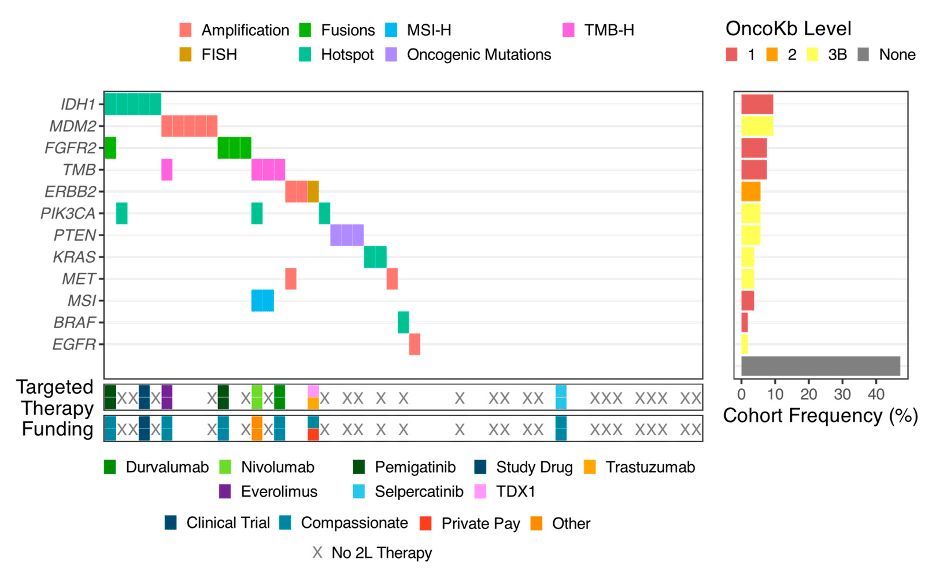
Ok, time to stop. The only other thing I will say is that the Canadian government is trying to take steps to reduce new drug access wait times (possibly the subject of a future, much shorter post). Shortening this time is obviously important to patients since a new drug could “convert” their tumour to resectable (this is language I’ve heard at conferences) — in other words, shrink the tumor enough so that it can be surgically removed, or at least prolong their lives and extend their quality of life for months or even years. And, it’s important to drug manufacturers. It’s clear from the various conferences I’ve attended where pharma company reps have been present that Canada’s long wait times are a serious deterrent to seeking approval in the first place.
Finally, learning all this has made it clear to me that zenocutuzumab will never be approved in Canada for public funding, certainly not in time for me, and possibly never. Our only hopes are, off the top of my head: (1) a big, rich pharma company buys Partner Therapeutics and establishes a compassionate use program, (2) we win the lottery, (3) we try again to get Ontario Health to pay for it through their Case-by-Case Review Program, and this time they approve it, (4) my university pays for some doses and/or orders our insurance company to pay for it, (5) some other drug company, maybe in China, invents a comparable drug, can manufacture it for far less, and sails through the Canadian approval process.


Leave a Reply